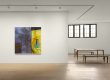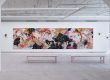

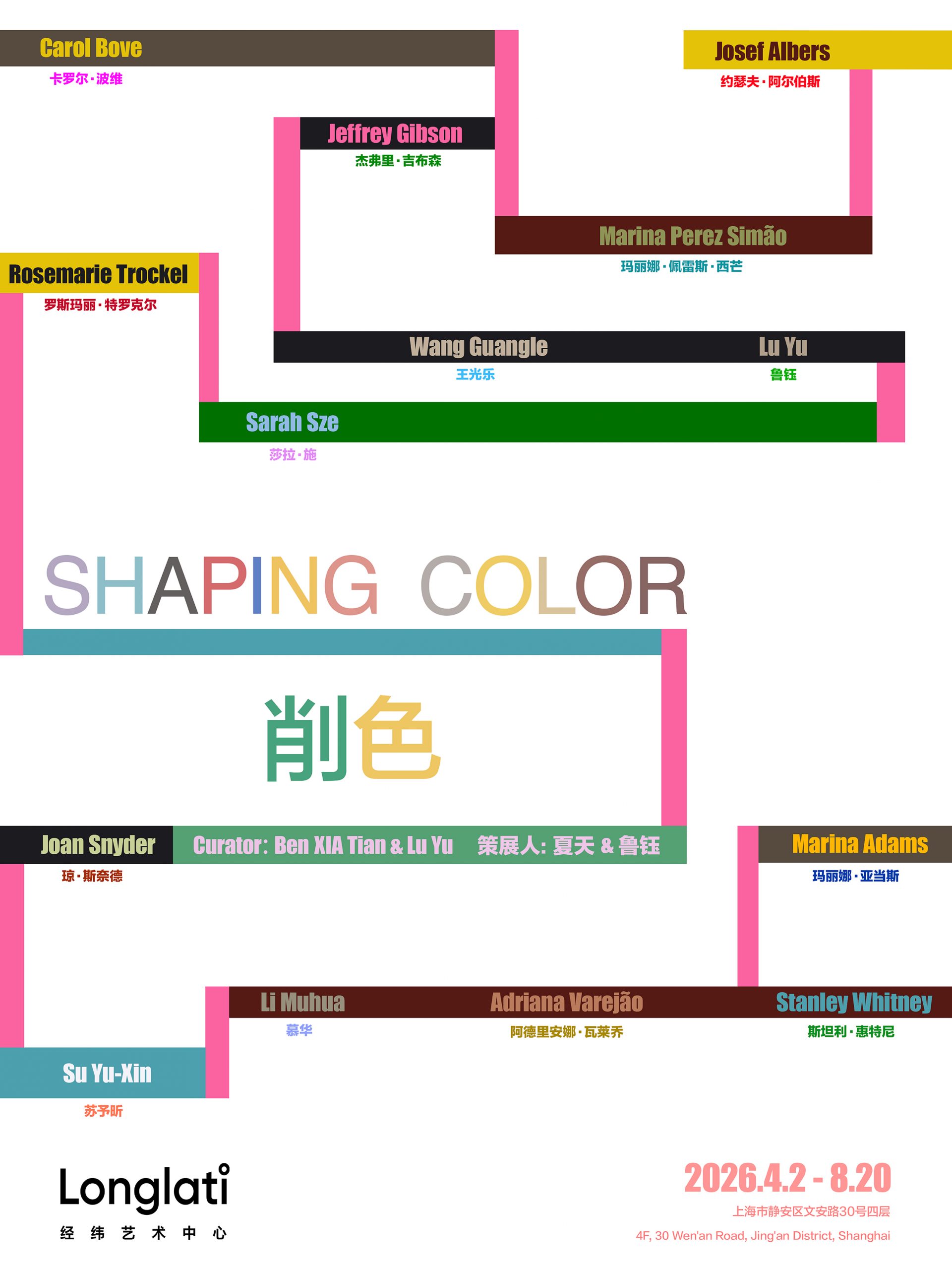
Longlati is pleased to present Shaping Color, a group exhibition featuring fourteen artists, opening on April 2nd, 2026. The exhibition title, Shaping Color, points to a recalibration of chromatic relations. In many artistic practices, color does not gain force through endless addition; rather, its structure gradually emerges through restriction, adjustment, and revision. Here, “shaping” names a process of visual judgment: color acquires new relations through contrast and arrangement. Through this exhibition, we ask: How do artists use color? How are chromatic relations established? And how do such relations form a formal structure that can be trusted? The exhibition brings together works by Marina Adams, Josef Albers, Carol Bove, Jeffrey Gibson, Wang Guangle, Muhua Li, Lu Yu, Marina Perez Simão, Joan Snyder, Su Yu-Xin, Sarah Sze, Rosemarie Trockel, Adriana Varejão, and Stanley Whitney.
Shaping Color places color in a position that calls for renewed reflection. Color has always been among the most immediate, and also the most complex, elements of visual experience. It shapes the rhythm of looking, the layering of space, the temperature of the picture, and it participates in the judgments through which perception and imagination take form. Color exists across painting, design, architecture, consumer goods, screen images, and industrial production. It has already become a highly condensed and widely circulating artistic language that speaks directly to the eye. For precisely this reason, color naturally occupies a central place in artistic practice and should be understood as one of the artist’s fundamental disciplines.
At the heart of the exhibition lies the ethical question of color. Ethics here points to a responsibility inherent within form. Color always appears in relation. One color changes through the presence of another, much like one person alters by encountering others, and it gains weight through boundary, scale, material, and light. Color is among the deepest structures of art, determining what is emphasized, subdued, brought forward, or pushed back. It is widely recognized that a “good” chromatic relation possesses a clear internal order while also sustaining an open perceptual field; it allows the picture, amid countless shifts of subject matter, to maintain a convincing balance.
The modern history of color unfolds across science, philosophy, and art education. In Opticks, Newton decomposed white light into a continuous spectrum through prism experiments and linked color to differing refractive properties, thereby laying the foundation for modern color science. Color first appears here as a physical phenomenon open to analysis. Goethe’s Theory of Colours shifted attention toward seeing itself, emphasizing the role of light and dark, visual boundary, afterimages, and subjective experience in the production of color. Color thus acquired a perceptual and psychological dimension. With Wittgenstein, the problem of color was transformed into a philosophical problem of language and judgment. In Remarks on Colour, he sought to clarify the logic of color concepts: how we “speak” color, how we “arrange” color, and why certain chromatic relations form the most basic order of everyday judgment.
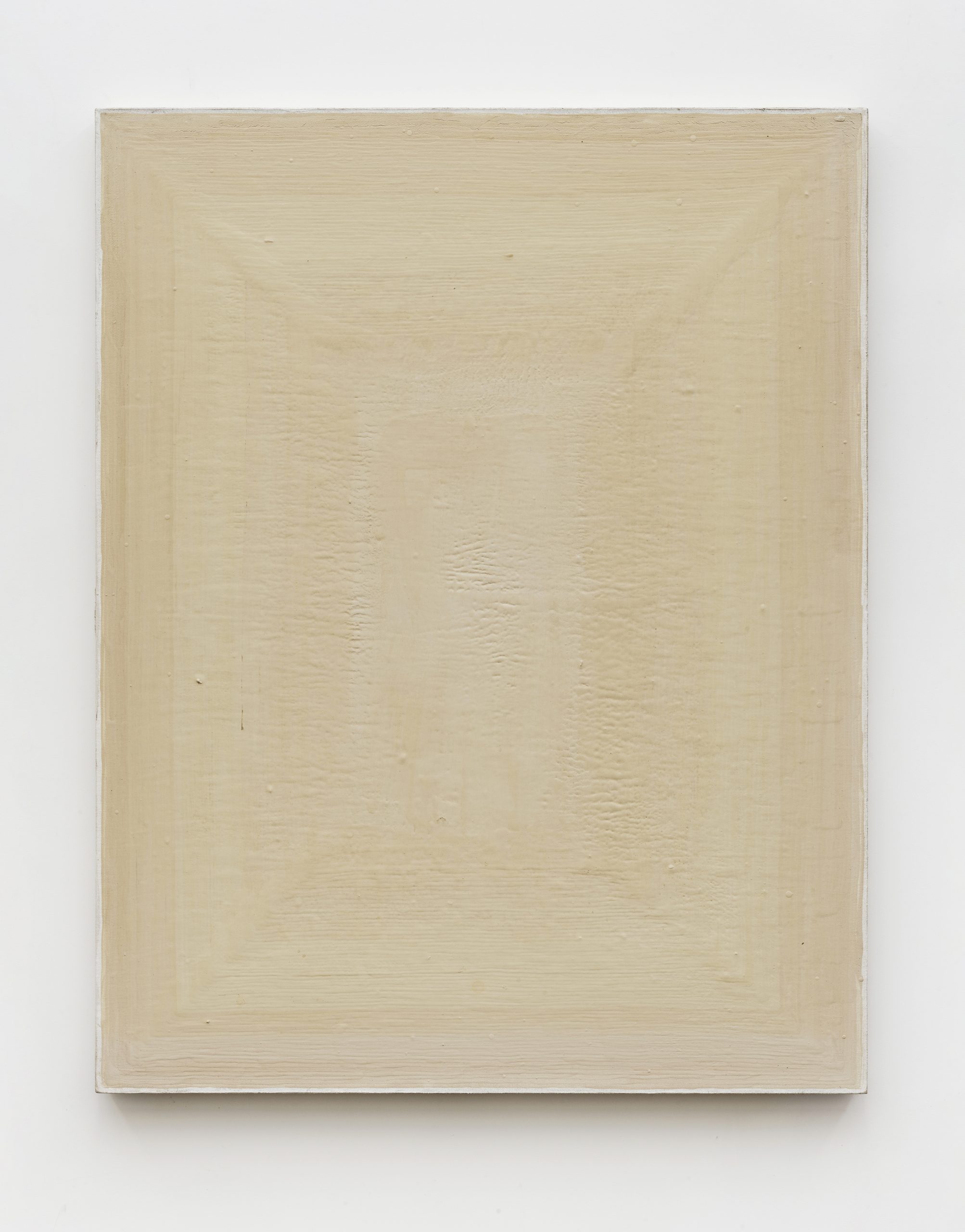
Wang Guangle, 191020, 2019, paint on canvas, 146 x 114 cm
Within the genealogy of modern art education, color developed from an auxiliary component of representational training into a foundational subject of visual education. Beginning with the Bauhaus, the systematic teaching of color developed by Johannes Itten, Josef Albers, and Vasiliy Kandinsky played a decisive role. Among them, Josef Albers, as a bridge between the old and new continents, turned color theory into a relational system that could be tested and worked through in practice. For Albers, color always appears through interaction; chromatic perception depends on adjacency and on the concrete conditions of scale and contrast. Color thus acquired a methodological meaning: what it trains is not merely a taste for combination, but an overall judgment of form. Albers’s Interaction of Color marks a key moment in art education. From the German Bauhaus to Black Mountain College and then Yale University, Albers, as an educator, nourished generations of artists, and the “experiments in color relations” he initiated resonated deeply throughout postwar and contemporary art.
The color of Shaping Color is plural. It shows how fourteen artists transform color into a purely constitutive force. Josef Albers places color within the strictest geometric framework, allowing chromatic blocks to define one another through complementarity and contrast, producing the greatest relational tension within the most economical structure. Stanley Whitney carries this relation from geometry into rhythm: his grids resemble jazz phrasing, making color leap like choreography. In Marina Adams’s work, color moves like the meeting of river and sea, advancing and receding to generate a dreamlike sense of space. Carol Bove, in a manner echoing Albers, overturns gravity, allowing color to become the soul that elevates matter. Lu Yu’s site-specific work considers the heterogeneous transformation of color and impurities within opacity. Muhua Li’s work responds, in figurative terms, to the legacy of Op Art: she uses primary colors with extreme economy, allowing restrained emotion to emerge through point, line, and plane.
Color also works alongside time. In Wang Guangle’s paintings, monochrome reveals almost microscopic geological differences through repeated layering and sanding. Joan Snyder lets pigment separate, congeal, clump, and nearly struggle against itself, so that color becomes the material exteriorization of emotion and bodily response. In Marina Perez Simão’s work, color becomes like a natural substance, sedimenting, crystallizing, emerging, and fading into histories of mountains and seas. In other works, color returns to an ancient natural matrix: Su Yu-Xin begins directly from minerals, soil, and hand-made pigments, revealing the multiple identities of terrain, craft, and scientific diagram; through crackled glaze, ochre, and Indigenous chromatic spectra, Adriana Varejão treats color as evidence of colonial history and cultural hybridity. In the work of Rosemarie Trockel, Jeffrey Gibson, and Sarah Sze, color becomes an allegory of industry and the contemporary environment. Trockel’s work stages a dialectic between coding and handwork, with agitation in line and color latent beneath a bleak surface. Gibson’s psychedelic palette triggers sensorial tremors; under the provocation of color, his symmetrical compositions become a kind of sleepless city. Sze’s work is a Travelers Among Streams and Mountains for the digital age: screen-like cold light, nodal objects, and mobile points of view together indicate that color today is no longer a static property, but part of a contemporary fluid interface.
Shaping Color reveals one facet among the many faces of color. The question it raises is how color acquires a structure that can itself be interrogated, and it underscores the ethical demands color places on artistic practice: the origin of color, its internal hierarchy, and its legitimacy. Shaping Color seeks to show the ethics with which artists apply color in form.
About Curator

Ben XIA Tian is a PhD in Philosophy, curator, and writer, currently teaching at Donghua University in Shanghai. His research and practice span curating, writing, and teaching, with a sustained focus on the intellectual history of art and design, as well as the mechanisms, conditions, and historical trajectories of production, mediation, and display in contemporary Chinese art.

Lu Yu, born in Chengdu, Sichuan in 1997, currently works and resides in Shanghai. In 2019, she graduated from Pratt Institute with a Bachelor of Fine Arts (BFA) degree.
Lu Yu approaches her artistic practice through the lens of epidemiology, analysing sociocultural issues as chronic diseases—investigating their modes of transmission among individuals and within society, and probing their causes, symptoms, complications, and potential interventions. Through artistic approaches and the use of mixed media, Lu translates obscure sociocultural issues into tangible and intelligible visual expressions, bringing the concealed yet ubiquitous pathologies of society into exposure.