
“All the works I have created for this exhibition embody a ‘leap’—a transition from one moment to another: from yesterday or today toward tomorrow, or from an unfavorable state to a better one. It is about steeling oneself in preparation for a future that holds the promise of improvement. Whether tomorrow arrives swiftly or feels a lifetime away becomes an experience determined by the self. That initial leap—that act of taking action—must be a meaningful step; one need not jump too far. A simple leap upward allows the path ahead to come into clearer, more measurable focus… setting the stage for the next leap forward.”
—Ay Tjoe Christine
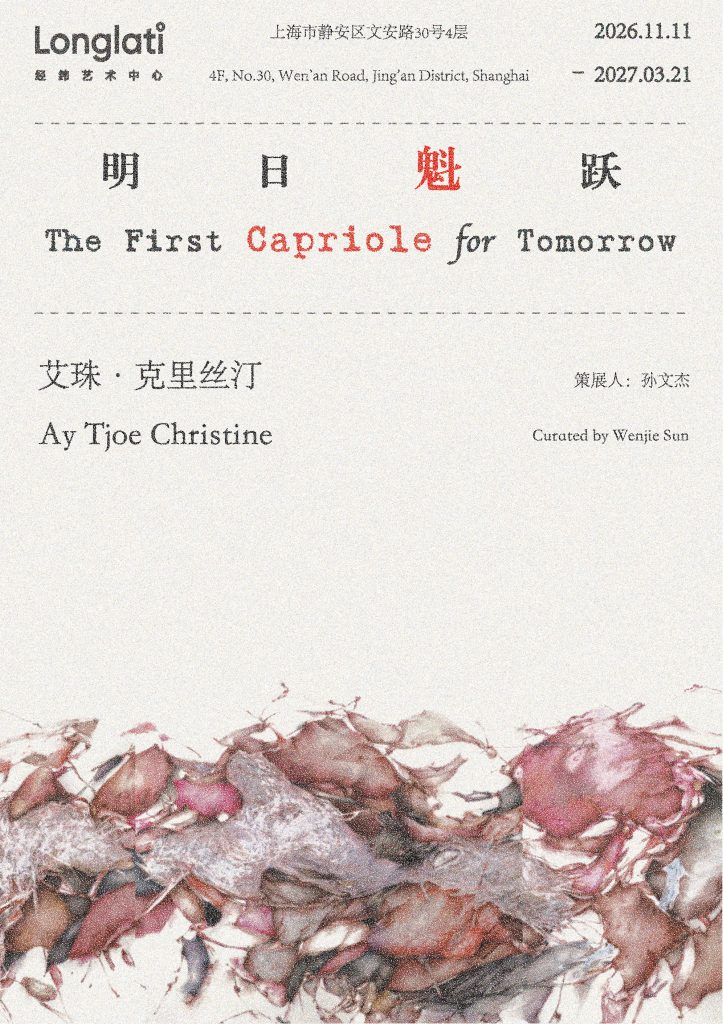
How does one reach a state of enduring goodness, peace, and restorative resilience? In the face of a shifting reality and an unpredictable living order, Ay Tjoe Christine offers a path defined by both prudence and hope through a visual narrative and site-specific installation spanning two gallery spaces, relinquishing the ultimate authority of interpretation and experience to every individual who walks into the exhibition. Opening this November, the artist’s solo exhibition, The First Capriole for Tomorrow, curated by Sun Wenjie, transforms Longlati into a spiritual sanctuary connecting the acts of “Rescaling the Self” and embracing a “True Tomorrow,” remaining on view through March 21, 2027.
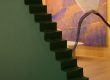
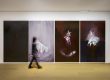
Stepping into the dimly lit installation gallery, typewriters suspended in mid-air immediately shatter our conventional imagination of this familiar tool. Ay Tjoe subverts the law of gravity from 16 years ago in Lama Sabakhtani #03 (2010)—where a typewriter lay flat on the floor—by lifting them into the air, suspended from dual oval tracks near the ceiling, or positioned sequentially along the curved gallery wall. Keys, transmission mechanisms, vibrations, sounds, and light interweave, turning these installations into a system in constant metamorphosis. The typewriter has long occupied a distinct and enduring place in Ay Tjoe’s practice; yet the nostalgia and comfort of sitting before a typewriter are now things of the past. Detached from the stability of a desk, the mechanical structures glide, drift, and resist easy hold along the tracks, echoing the abrupt, disorienting shifts in modern existence. An instrument once designed to transmit language is no longer a mere object of control; its movement in turn reshapes human behavior, compelling the body to adapt to an unfamiliar mode of interaction and an unpredictable velocity. Keys, gears, vibrations, acoustics, puffs of fine dust, and sudden blackouts coalesce, transforming the entire gallery into an ever-evolving dynamic system.
Within this system, language invades the space in diverse, tactile forms: printed onto cardboard, carved into stones, or projected as luminous lines across dark walls—words drawn from the Holy Scriptures that convey profound solace. Language is commonly understood as the expression of abstract thought, yet as literary movements like Concrete Poetry demonstrate, words can be transformed into physical existences to be perceived as tangible objects rather than merely read.
Ay Tjoe’s installation brings language back to the body: fingers search for keys, strike mechanical parts, and characters subsequently materialize; in her paintings, this corporeality manifests as the artist directly uses her hands to push, smear, rub, and score oil bars across the canvas, leaving visceral, embodied traces. Expression is never a fully transparent, frictionless process; it must endure the physical encounter between body and material, often accompanied by error, pain, and repeated attempts. Thinking is inherently spatial and embodied—even abstract ethical concepts like “justice” and “peace” are rooted in somatic responses within the body. Physical gestures are a living record of thought, mapping ideas and storing memory before words arrive.
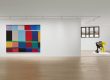
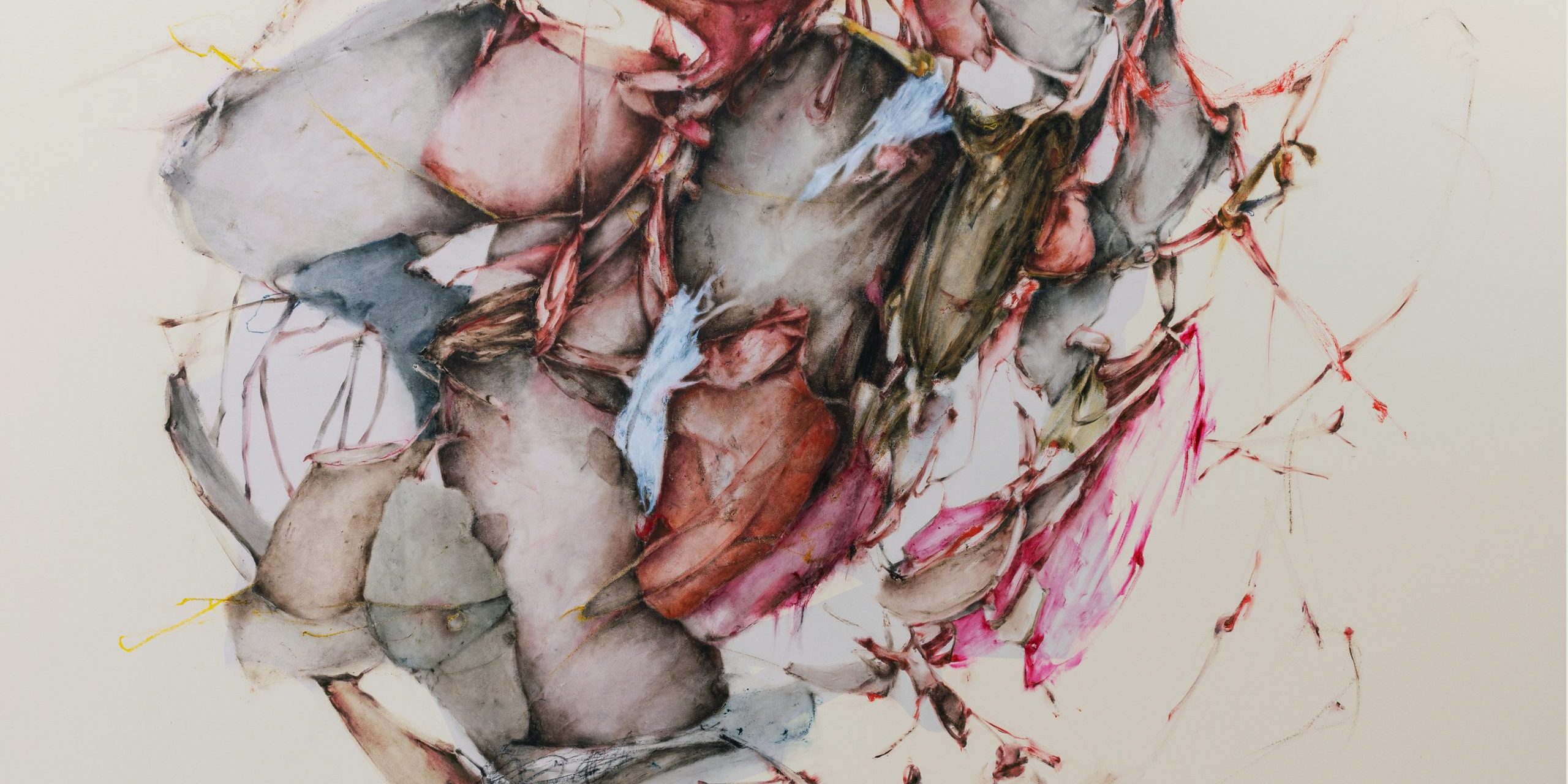
If Ay Tjoe leaves traces of thought through physical gestures in her painting, her monumental first triptych, Rescaling the Self with the True Tomorrow #01 (2026), brings these marks into a nuanced dialogue and layered resonance across the panels. At the center of the painting, muted greyish-white matter tightly entwines with crimson and flesh-pink tones, interspersed with charcoal cores; brushstrokes, color fields, and web-like lines extend across the canvases, fracturing as they cross the joins. The three panels form an expansive whole without erasing their boundaries as individual living entities. Continuity and rupture, aggregation and dispersion coexist—an organic form in perpetual growth spanning the 5.4-meter canvas. Its fluid, explosive morphology evokes bodily organs, coagulations, swelling cells, cocoons, or dense plant roots, guiding the viewer into a microscopic yet introspective, boundless cosmos.
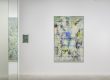
In two other works titled The Idea of Rescaling Self (2026), which exhibit a similar outward-expanding rhythm, a larger proportion of negative space constructs a sanctuary of order and stillness for the viewer. This negative space, together with two paintings from her Cryptobiosis series in the gallery, reflects the artist’s observations and reflections in her studio beside the forest in Bandung: under extreme conditions, microscopic organisms like tardigrades reduce their metabolic activity to a minimum, surviving in a state near stasis. This phenomenon led her to re-examine the fundamental necessities of life and advocate, through her notion of the “Lesser Numerator,” an ethos of restraint in an era of expanding desires, exploring the generative tension between limitation and freedom. As her practice unfolds, the palette shifts from the hope-infused sky blues, greys, and beiges of Cryptobiosis into the coagulated crimson and flesh pink of the Covered and Cover series—resembling a blood clot. Here, color assumes the starring role in an emotional narrative, transforming family silence and the complex grief bound up in filial piety into a protective, healing force of covering.
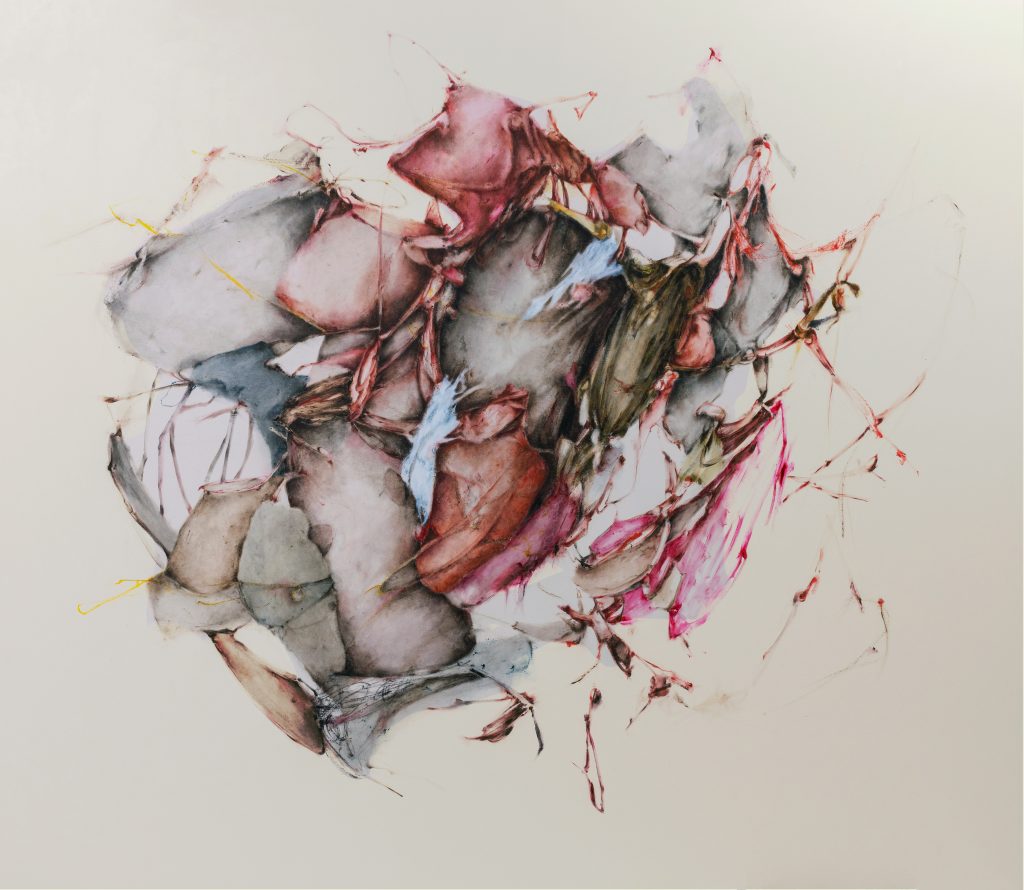
Ay Tjoe Christine, Rescaling the Self with the True Tomorrow #02, 2026, oil on canvas, 200 × 230 cm © Ay Tjoe Christine. Courtesy of the artist and Ota Fine Arts
For Ay Tjoe Christine, artistic work is fundamentally an inward journey. The inner realm is by no means a closed, static territory waiting to be uncovered; it is perceived and shaped through the observation of nature, repeated friction with materials, and moments that disrupt existing orders, forcing one to re-examine life. Existence itself is an event unfolding from interior experience. Confronted by shifts in circumstances or moments of vulnerability and mourning, the artist continuously rebuilds connections—with materials, with others, and with the future—through her physical practice, steadfastly pursuing righteousness and peace while embracing a life in constant flux; her practice thus becomes an ongoing process of self-discovery.
The First Capriole for Tomorrow points precisely to such an unfinished movement. In Ay Tjoe’s view, the “capriole” signifies an upward leap—a gesture that implies temporarily relinquishing one’s original support, yet making a new direction possible. This practice of continuously adjusting one’s relationship with the world extends into a recalibration of the self, directing our gaze toward a time not yet arrived, but imbued with certain hope: tomorrow.
About the Artist
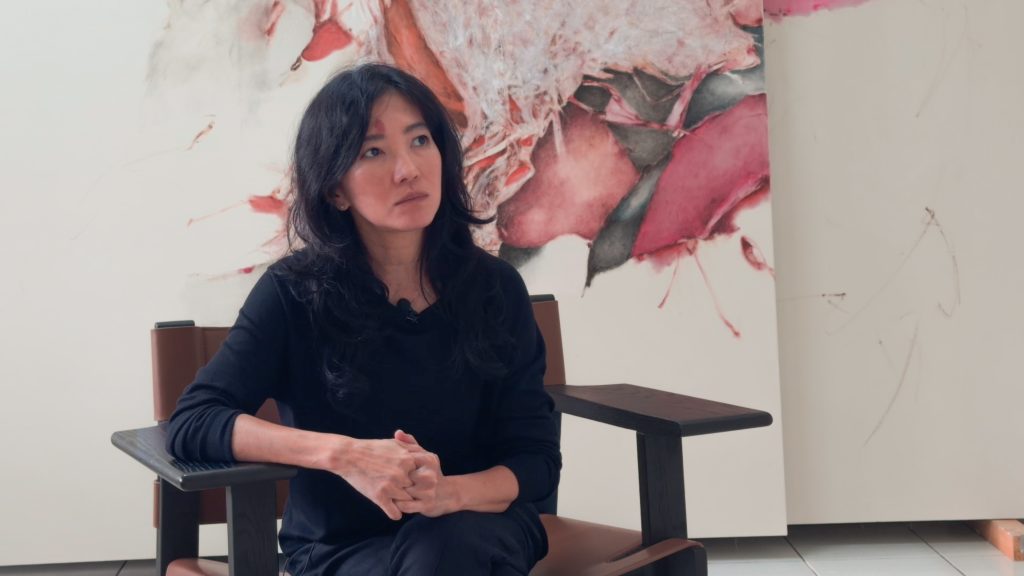
Ay Tjoe Christine. © Ay Tjoe Christine. Courtesy of the artist and Ota Fine Arts
Ay Tjoe Christine (b. 1973, Bandung, Indonesia) lives and works in Bandung, Indonesia. In 1997, she graduated from the Faculty of Art and Design (FSRDITB), Graphic Art, Bandung, Indonesia.
Ay Tjoe’s selected solo exhibitions include “Covered and Cover” White Cube, New York (2025), “The Uncompromising #01” Ota Fine Arts, Shanghai, China (2023) “Christine Ay Tjoe”, Kunstmuseum Schloss Derneburg, Hall Art Foundation, Germany (2022), “The Black Side” Ota Fine Arts, Shanghai, China (2018), “Ay Tjoe Christine: Spirituality and Allegory”, 21st Century Museum of Contemporary Art, Kanazawa, Japan (2018), “Christine Ay Tjoe: Perfect Imperfection”, Song Eun Art Space, Seoul, Korea (2015) and “Myriad of ‘paste’”, Ota Fine Arts, Tokyo, Japan (2013). She has participated in notable group exhibitions including “Prudential Eye Award”, Art Science Museum, Singapore (2015), “The Asia Breweries Foundation Signature Art Prize 2011 Finalists Exhibition”, Singapore Art Museum, Singapore (2012), “Future Pass”, National Taiwan Museum of Fine Arts, Taiwan, China (2012) and “Indonesian Eye: Fantasies and Realities”, Saatchi Gallery, London (2011). Ay Tjoe’s works are held in the collections such as 21st Century Museum of Contemporary Art (Japan), The Metropolitan Museum of Art (USA), Asia Society Museum (USA), Museum of Fine Arts, Boston (USA), Singapore Art Museum (Singapore), Museum MACAN (Indonesia), Akili Museum of Art (Indonesia), M+ Museum (Hong Kong, China) and Rockbund Art Museum (China).